
Applying for a quick loan online Philippines borrowers can access in minutes may look simple on the surface, but approval decisions are heavily influenced by preparation. Most online lenders now rely on automated risk checks, digital identity verification, and onboarding systems that evaluate applicants within seconds.
For first-time borrowers, freelancers, gig workers, and even salaried employees, the biggest reason applications fail is not always low income. Missing documents, inconsistent personal information, invalid IDs, weak verification records, or incomplete digital profiles often trigger rejection before a lender even reviews repayment capacity.
This article explains the actual eligibility standards, document expectations, KYC verification processes, and onboarding behaviors commonly used by Philippine online lenders today.
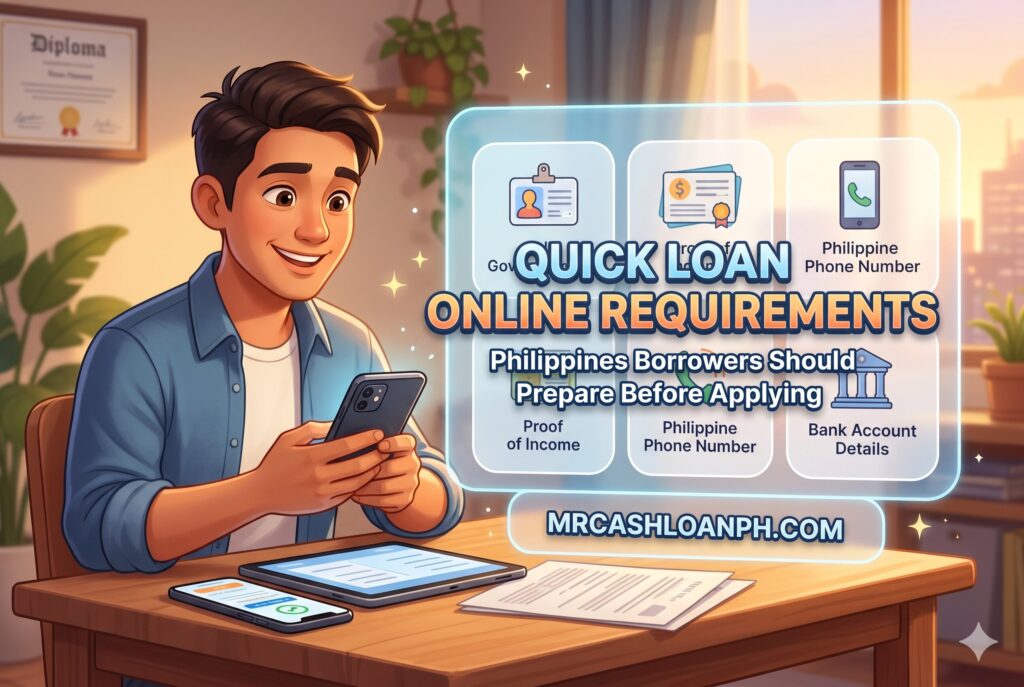
📌 What Do You Need to Prepare for an Online Quick Loan?
Most online lenders in the Philippines commonly require:
- Valid government-issued ID
- Active mobile number
- Personal selfie or facial verification
- Proof of income or cash flow
- Philippine residency information
- Active e-wallet or bank account
- Stable contact details
- Age requirement compliance
- Digital onboarding verification
Borrowers who prepare these in advance usually complete applications faster and reduce the risk of delays or rejection.
Why Online Loan Requirements Have Become Stricter 📱
Digital Lending Platforms Now Use Automated Risk Screening
Many online lending apps no longer rely entirely on manual review teams. Instead, fintech platforms use automated systems to evaluate:
- Identity legitimacy
- Fraud indicators
- Income consistency
- Device behavior
- Duplicate applications
- Contact information validity
- Repayment probability
This shift happened as digital lending expanded rapidly across the Philippines. Online lenders now balance fast approvals with stricter fraud prevention measures.
Borrowers sometimes assume “quick approval” means minimal verification. In practice, lenders still conduct KYC checks and borrower screening – only faster and more digitally.
BSP-Aligned Compliance Increased Verification Expectations
Many licensed digital lenders follow onboarding practices influenced by anti-fraud and customer verification standards used across the financial sector.
Common compliance-focused checks include:
- Facial recognition
- ID authenticity validation
- Mobile OTP verification
- Address consistency checks
- Duplicate identity detection
- Transaction account ownership validation
These processes help lenders reduce identity fraud, fake accounts, and synthetic borrower profiles.
Core Eligibility Requirements Most Online Lenders Expect
Age and Residency Requirements
Most Philippine online lenders require borrowers to:
| Requirement | Typical Expectation |
|---|---|
| Minimum age | 18 to 21 years old |
| Maximum age | Often 60 to 70 years old |
| Residency | Philippine resident |
| Mobile number | Active local SIM |
| Identification | Valid government-issued ID |
Some platforms impose stricter minimum age requirements for first-time borrowers because younger applicants statistically carry higher lending risk.
Foreign nationals may qualify on certain platforms if they can provide long-term residency documentation and valid identification.
Stable Income Still Matters – Even for Small Loans
A common misconception is that small online loans require no income validation.
In reality, lenders still assess repayment ability through:
- Payslips
- Bank transactions
- E-wallet cash flow
- Remittance history
- Freelance income records
- Online selling transactions
- Employment certificates
Even when a lender advertises “minimal requirements,” their system may still estimate income using alternative financial behavior data.
Borrowers searching for quick loan for bad credit borrowers often assume income verification disappears entirely. Most lenders still evaluate repayment capacity even if they are flexible on formal credit history.
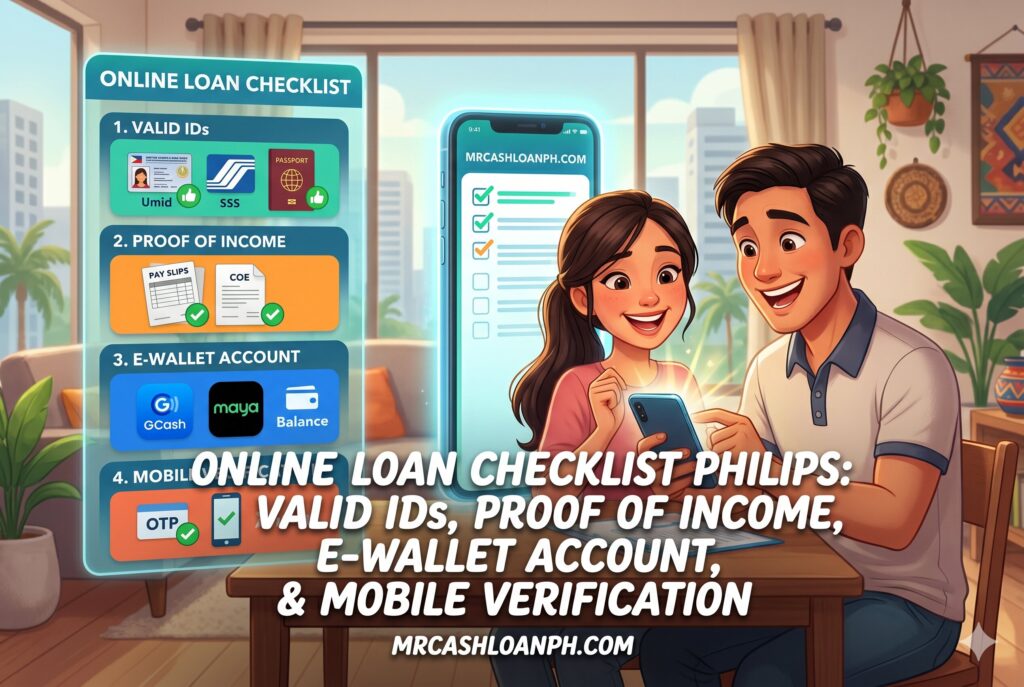
Valid IDs, proof of income, e-wallet account, and mobile verification for online quick loan applications in the Philippines
Valid IDs Commonly Accepted by Online Lenders 🪪
Government IDs Usually Accepted
Most digital lenders prioritize government-issued IDs with clear photos and readable information.
Commonly accepted IDs include:
- UMID
- PhilSys National ID
- Driver’s License
- Passport
- PRC ID
- Voter’s ID
- Postal ID
- SSS ID
- PhilHealth ID
- TIN ID (limited acceptance on some platforms)
The ID must usually be:
- Unexpired
- Undamaged
- Clearly photographed
- Fully visible within the frame
- Consistent with submitted information
Blurred photos remain one of the most common onboarding problems.
Why Selfies and Facial Verification Matter
Most online lenders now require borrowers to submit:
- Live selfie verification
- Face movement checks
- ID-to-face matching
- Anti-spoofing detection
These systems compare facial data with uploaded IDs to reduce identity theft.
Borrowers sometimes fail verification because of:
- Poor lighting
- Wearing hats or masks
- Heavy filters
- Low camera quality
- Cropped face positioning
Good lighting and stable internet connection significantly improve onboarding success.
Proof of Income Requirements Explained 💸
Traditional Employees Usually Submit These Documents
Employed applicants are commonly asked for:
- Payslips
- Certificate of Employment
- Company ID
- Payroll bank statements
- Income tax records in some cases
Some lenders also verify employers through:
- Corporate email checks
- HR contact validation
- Employment duration review
Applicants with stable employment histories generally face fewer onboarding complications.
Freelancers and Gig Workers Can Still Qualify
Freelancers, online sellers, ride-hailing drivers, and self-employed applicants increasingly qualify for digital loans because lenders now evaluate broader income patterns.
Alternative proof of income may include:
- GCash transaction history
- Maya wallet records
- Online marketplace sales
- Client invoices
- Freelance platform payouts
- Bank transaction screenshots
- Remittance records
This shift reflects how many Filipinos now earn outside traditional employment systems.
Borrowers exploring the best quick loan apps online Philippines often notice platforms promoting “flexible income requirements.” Usually, this means lenders accept alternative cash flow evidence instead of formal payroll documents.
Can You Apply Without Payslips?
Yes, some lenders allow applications without payslips, especially for:
- Freelancers
- Self-employed borrowers
- Online sellers
- Gig workers
- Seasonal earners
However, alternative income verification is still typically required.
Lenders may instead analyze:
- Transaction frequency
- Cash inflow consistency
- Wallet activity
- Bank deposits
- Utility payment behavior
No-payslip applications are rarely “no verification” applications.
Bank Accounts vs E-Wallet Requirements
Do Online Lenders Require Bank Accounts?
Not always.
Many Philippine digital lenders now support:
- GCash
- Maya
- Coins.ph
- Traditional banks
- Digital banks
Some borrowers receive disbursement directly through e-wallet providers rather than bank transfers.
This became increasingly common as e-wallet adoption expanded across the country.
Why E-Wallet Ownership Verification Matters
Lenders often verify whether:
- The e-wallet account matches the borrower’s name
- The mobile number is active
- The account shows transaction activity
Inactive or mismatched accounts may delay approval.
Some platforms reject applications when the disbursement account belongs to another person.
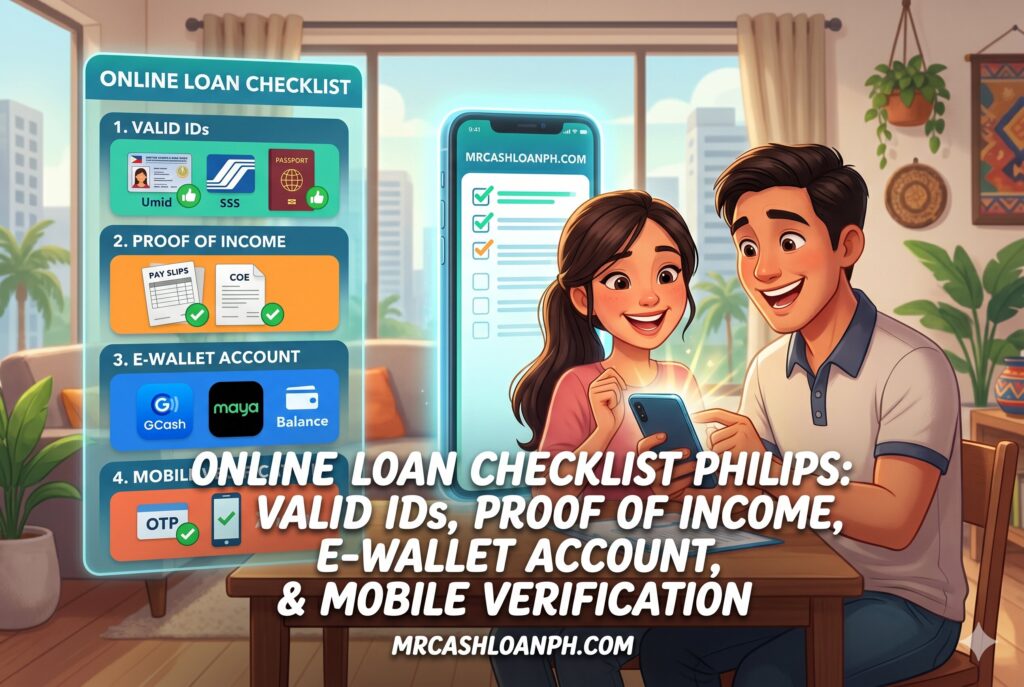
Borrower completing selfie verification and KYC identity checks during Philippine online loan application
How KYC Verification Works During Online Loan Applications 🔍
KYC Is More Than Just Uploading an ID
KYC (Know Your Customer) verification combines multiple checks:
| Verification Layer | Purpose |
|---|---|
| ID validation | Confirm identity legitimacy |
| Facial recognition | Match borrower to ID |
| Mobile verification | Confirm active phone access |
| Address checks | Reduce fake applications |
| Device monitoring | Detect suspicious activity |
| Database cross-checking | Identify duplicate profiles |
Most borrowers only see the upload process, but lenders run multiple background checks simultaneously.
Borrower Behavior Can Affect Approval Outcomes
Online lenders also analyze behavioral indicators during onboarding.
Examples include:
- Typing inconsistencies
- Multiple rapid applications
- Suspicious device switching
- VPN usage
- Fake GPS indicators
- Repeated rejected attempts
These anti-fraud systems help lenders identify high-risk digital behavior patterns.
Applicants sometimes wonder why online loan applications get rejected even when documents appear complete. Automated fraud scoring is often part of the answer.
Residency and Contact Information Checks
Address Consistency Is Important
Borrowers should ensure consistency across:
- IDs
- Utility bills
- Application forms
- Delivery addresses
- Billing records
Major discrepancies can trigger manual review.
Some lenders request:
- Barangay certificates
- Utility bills
- Lease documents
- Proof of residence
This is especially common for larger loan amounts.
Active Mobile Numbers Improve Verification Success
The mobile number used during application often becomes central to account verification.
Lenders may use it for:
- OTP authentication
- Device linkage
- Payment reminders
- Fraud detection
- Identity consistency checks
Changing numbers frequently can complicate future applications.
Common Reasons Borrowers Fail Requirement Checks ❌
Incomplete or Poor-Quality Documents
Frequent onboarding issues include:
- Cropped IDs
- Blurry uploads
- Expired identification
- Mismatched names
- Fake documents
- Inconsistent signatures
Many automated systems instantly reject unreadable uploads.
Income Signals Do Not Match Declared Information
Problems may arise when:
- Declared salary differs from transaction history
- Employment records cannot be verified
- Wallet activity contradicts stated income
- Bank records show irregular cash flow
Lenders increasingly compare declared financial data against digital transaction behavior.
Too Many Simultaneous Applications
Applying across many platforms within a short period may appear risky.
Some lenders interpret this as:
- Financial distress
- Fraud attempts
- High default probability
Borrowers are usually better off preparing one strong application instead of mass-applying randomly.
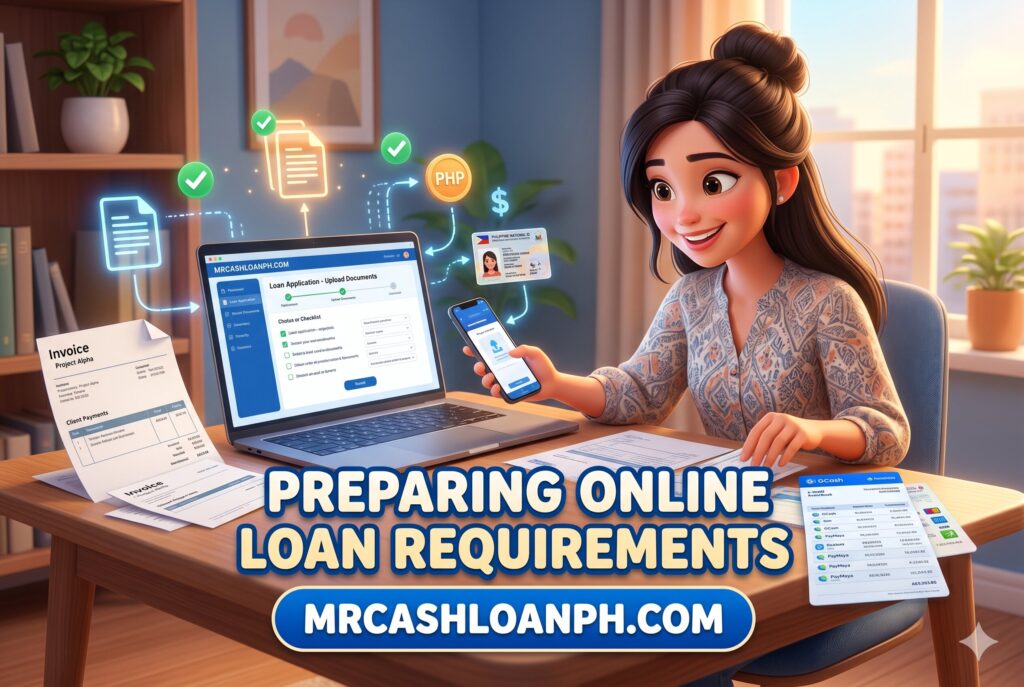
Freelancer organizing invoices, e-wallet records, and identification for quick online loan application
What First-Time Borrowers Should Prepare Before Applying 📝
Organize Digital Copies in Advance
Before starting an application, borrowers should prepare:
- Clear ID photos
- PDF income documents
- Updated contact information
- Stable internet connection
- Active e-wallet or bank account
This minimizes onboarding interruptions.
Check Information Consistency Carefully
Names, birthdates, addresses, and mobile numbers should match across documents.
Even small inconsistencies sometimes trigger:
- Manual verification
- Delays
- Rejection
- Additional document requests
Accuracy matters because most digital onboarding systems are automated.
How Self-Employed and Freelance Applicants Improve Approval Chances
Show Consistent Cash Flow Instead of Irregular Lump Sums
Lenders often prefer:
- Regular transactions
- Predictable deposits
- Stable wallet activity
Large but inconsistent income spikes may appear less reliable than smaller recurring cash inflows.
Maintain Active Financial Accounts
Inactive accounts reduce credibility signals.
Borrowers improve onboarding readiness by maintaining:
- Regular e-wallet usage
- Consistent banking activity
- Updated account ownership details
- Verified financial profiles
Some digital lenders now evaluate financial ecosystem activity instead of relying only on traditional employment records.
What Documents Are Needed for Online Loans?
The exact requirements vary, but most lenders commonly request:
Basic Requirements
- Government-issued ID
- Mobile number
- Selfie verification
- Proof of address
Income-Related Requirements
- Payslips
- Bank statements
- E-wallet transactions
- Client invoices
- Employment certificates
Additional Verification Documents
- Utility bills
- Barangay certificates
- Tax records for self-employed applicants
Preparing these before applying helps reduce delays.
What IDs Are Accepted?
Most online lenders accept:
- PhilSys ID
- UMID
- Passport
- Driver’s License
- PRC ID
- Postal ID
Acceptance policies vary by platform.
Temporary IDs, damaged cards, and unreadable photos are commonly rejected.
Can Freelancers Qualify for Quick Loans?
Yes. Many digital lenders now accommodate:
- Freelancers
- Content creators
- Online sellers
- Delivery riders
- Ride-hailing drivers
- Remote workers
The key factor is usually verifiable income activity rather than formal employment status alone.
Applicants who maintain organized financial records generally experience smoother onboarding.
Do Online Lenders Require Bank Accounts?
Not always.
Many lenders now disburse funds through:
- GCash
- Maya
- Digital banks
- Traditional bank accounts
However, the account usually must:
- Match the borrower’s identity
- Remain active
- Support transaction verification
Smart Preparation Tips Before Submitting an Application ✔️
Double-Check Your Documents
Before uploading:
- Verify image clarity
- Ensure IDs are not expired
- Confirm names match exactly
- Review address details carefully
Avoid Editing or Altering Files
Lenders use systems that detect:
- Manipulated images
- Fake screenshots
- Altered PDFs
- Inconsistent metadata
Authentic documents reduce fraud flags.
Use Your Own Accounts and Devices
Applications become riskier when borrowers:
- Use shared devices
- Submit another person’s bank account
- Register using borrowed SIM cards
Identity consistency matters heavily in digital lending ecosystems.
Read Permission Requests Carefully
Some lending apps request access to:
- Camera
- SMS verification
- Device information
Borrowers should only apply through legitimate and transparent platforms.
Conclusion
Preparing for a quick online loan application in the Philippines now involves much more than uploading an ID and waiting for approval. Digital lenders increasingly rely on automated KYC systems, identity verification tools, income validation processes, and fraud detection technology to evaluate borrower readiness.
Whether you are a salaried employee, freelancer, online seller, or gig worker, preparation significantly affects approval outcomes. Clean documentation, consistent personal information, active financial accounts, and realistic income records help lenders verify legitimacy faster and reduce onboarding friction.
Borrowers should also approach digital lending responsibly. Applying only when necessary, reviewing platform legitimacy carefully, and submitting truthful information remain essential habits in today’s Philippine fintech environment.
Well-prepared applications not only improve approval potential – they also help borrowers avoid delays, repeated rejections, and unnecessary financial stress.
Last Updated on September 11, 2026 by David Vargas
