
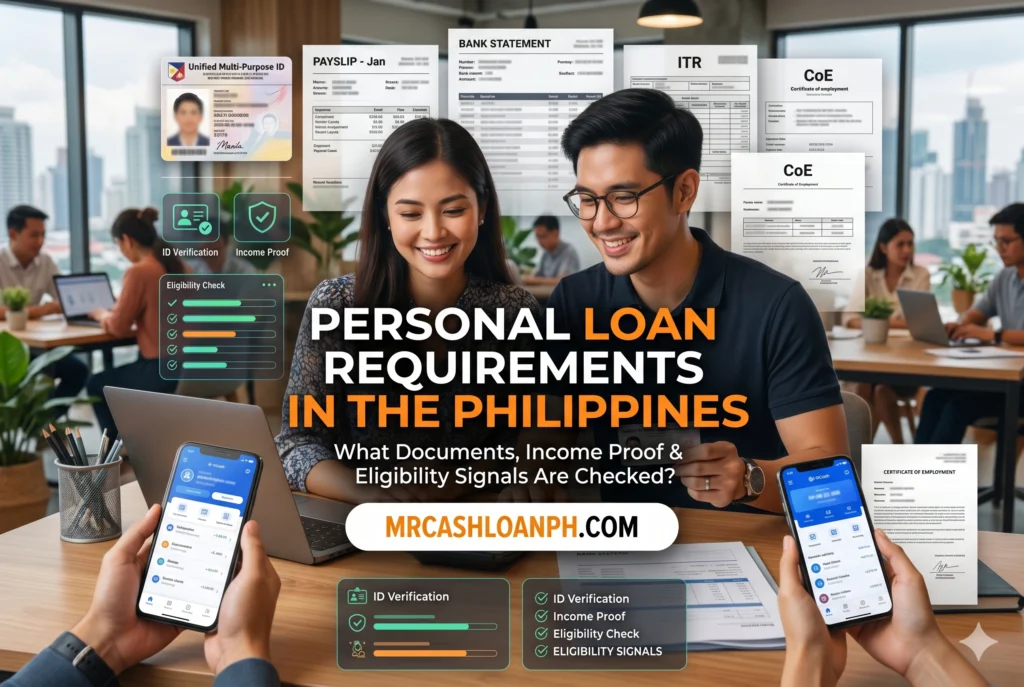
Applying for a personal loan in the Philippines has become much easier thanks to digital banks, fintech lenders, and mobile-first application systems. However, many borrowers still get confused about one crucial question:
What exactly do lenders require before they even evaluate a loan application?
The answer goes beyond simply uploading a valid ID. Modern lenders assess identity, income stability, employment consistency, repayment capacity, credit behavior, and fraud-risk indicators before moving an application forward.
Whether you are a salaried employee, freelancer, online seller, gig worker, or self-employed business owner, knowing the common requirements beforehand can significantly improve application readiness and reduce verification delays.
Quick Comparison Table: Common Personal Loan Requirements in the Philippines
| Requirement Category | Employed Applicant | Freelancer | Self-Employed |
|---|---|---|---|
| Government ID | Required | Required | Required |
| Selfie Verification | Usually Required | Usually Required | Usually Required |
| Proof of Income | Payslips, COE | Contracts, invoices, bank statements | ITR, business records |
| Bank Statements | Sometimes Required | Commonly Required | Commonly Required |
| Proof of Billing | Often Requested | Often Requested | Often Requested |
| Employment Verification | Common | Not Applicable | Not Applicable |
| Business Registration | Not Required | Sometimes Helpful | Usually Required |
| Credit History Check | Common | Common | Common |
| Mobile Number Verification | Required | Required | Required |
| Email Verification | Required | Required | Required |
Summary
Personal loan requirements in the Philippines generally include a valid government-issued ID, proof of income, contact verification, and evidence of financial capacity. Most lenders verify employment, analyze bank account activity, review credit records, and perform identity validation through KYC procedures. Employed borrowers typically submit payslips and a Certificate of Employment (COE), while freelancers and self-employed applicants often provide bank statements, contracts, invoices, tax documents, or business records. Preparing these documents before applying can improve processing efficiency and reduce verification issues.
🤔 What are the minimum personal loan requirements in the Philippines?
Most lenders require proof of identity, proof of income, and evidence that you can repay the loan.
While specific requirements vary between banks and lending platforms, several eligibility standards are consistently used throughout the Philippine lending industry.
Typical baseline requirements include:
- Filipino citizen or eligible resident
- Valid government-issued ID
- Active mobile number
- Active email address
- Verifiable source of income
- Philippine bank account or e-wallet account
- Residential address
- Minimum age requirement (usually 21 years or older)
- Stable income source
Lenders increasingly use digital onboarding systems that combine document review, selfie verification, OTP authentication, and behavioral risk checks before an application proceeds to underwriting.
A common borrower misconception is that income alone guarantees eligibility. In practice, lenders evaluate whether income can be verified consistently.
🪪 Which government IDs are usually accepted for personal loan applications?
Valid government-issued identification is one of the most important requirements because it supports Know-Your-Customer (KYC) verification.
Commonly accepted IDs include:
- Philippine National ID
- Driver’s License
- Passport
- UMID
- SSS ID
- GSIS ID
- PRC ID
- Postal ID (where accepted)
- Voter’s ID (if accepted by the lender)
Why do lenders sometimes reject valid IDs?
An ID can be valid yet still fail verification if image quality or data consistency issues exist.
Common rejection causes include:
- Blurry photos
- Cropped images
- Expired IDs
- Damaged IDs
- Mismatched names
- Obstructed ID numbers
- Poor lighting
Many modern lending apps use AI-assisted identity verification systems that compare submitted IDs with selfie images and application details.
💰 What proof of income do lenders normally require?
Income verification helps lenders determine whether a borrower has sufficient repayment capacity.
The exact documentation depends on the applicant’s income source.
What income documents are required for employed applicants?
Most salaried employees submit recent payslips, a Certificate of Employment (COE), or both.
Common requirements include:
- Latest payslips
- Certificate of Employment (COE)
- Company ID
- Latest Income Tax Return (if requested)
- Payroll bank statements
Lenders may also verify:
- Employment status
- Job title
- Length of employment
- Company contact information
One practical observation from Philippine lending operations is that longer employment tenure often strengthens application confidence because it suggests income stability.
What income documents are required for freelancers?
Freelancers can qualify if they can demonstrate consistent income despite lacking traditional employment records.
Common documents include:
- Client contracts
- Service agreements
- Invoice history
- Payment receipts
- Bank statements
- Platform earnings records
- Tax filings
Freelancers who regularly receive payments through digital platforms often benefit from maintaining organized transaction records.
What income documents are required for self-employed applicants?
Self-employed borrowers typically need to demonstrate business activity and cash flow.
Frequently requested documents include:
- BIR tax records
- Income Tax Return (ITR)
- Business permits
- DTI registration
- SEC registration
- Audited financial statements
- Bank statements
Many lenders place significant emphasis on cash-flow consistency rather than business size alone.
🏦 Why do lenders ask for bank statements?
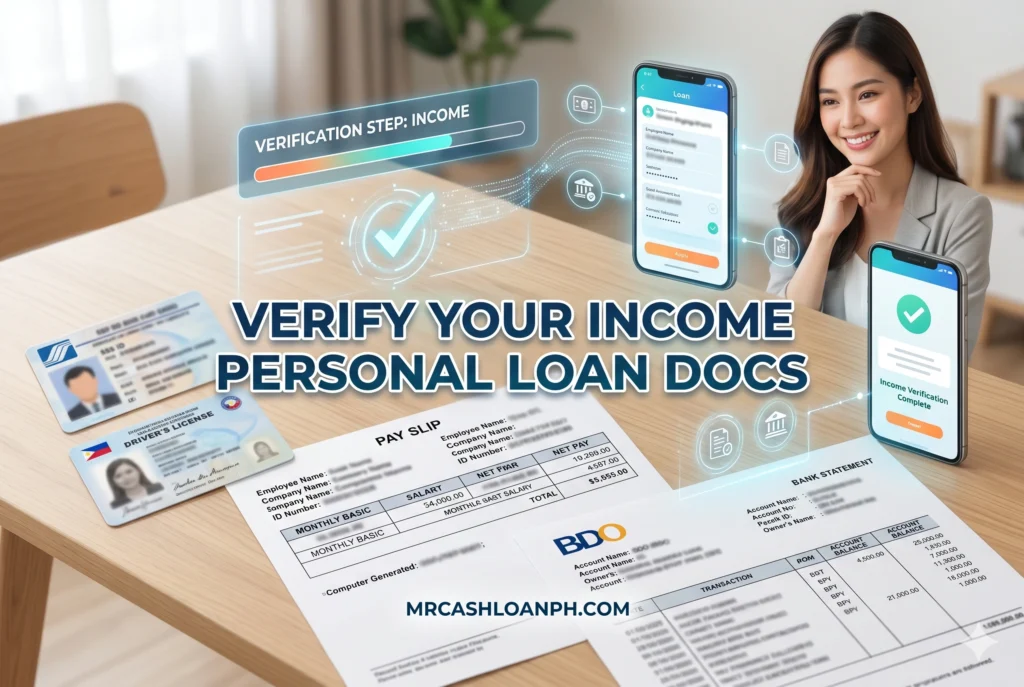
Bank statements help lenders validate income consistency and detect discrepancies between declared and actual cash flow.
A bank statement can reveal:
- Salary deposits
- Business revenue
- Freelance earnings
- Transaction frequency
- Average account balance
- Financial activity patterns
From a risk-assessment perspective, bank statements often provide more practical insight than a single payslip because they reflect ongoing financial behavior.
Applicants should ensure:
- Account name matches application details
- Transactions are visible
- Statements are recent
- Files are complete
📄 Is proof of billing still required by lenders?
Yes, many lenders continue to request proof of address even in digital-first lending environments.
Accepted proof of billing documents may include:
- Utility bills
- Internet bills
- Water bills
- Credit card statements
- Bank correspondence
Why do lenders verify residential addresses?
Address verification supports identity validation and fraud prevention.
It helps lenders:
- Confirm borrower identity
- Reduce synthetic identity fraud
- Verify geographic information
- Support regulatory compliance
Even when not mandatory during initial application stages, proof of billing may be requested during enhanced verification reviews.
👔 How do lenders verify employment information?
Employment verification is commonly used to confirm income legitimacy and reduce fraud risk.
Verification methods may include:
- Employer database checks
- HR confirmation calls
- Company email validation
- Employment record verification
Will every lender contact my employer?
Not necessarily. Verification practices vary significantly across lenders.
Some digital lenders rely heavily on document-based verification, while banks and larger financial institutions may conduct direct employment checks.
Community-reported borrower experiences indicate that employment verification remains a common step among traditional lenders, particularly for larger loan amounts.
What information is usually verified?
Common checks include:
- Employment status
- Position title
- Employment duration
- Work email
- Company contact details
Lenders generally do not need detailed personal employment records beyond what is necessary for credit evaluation.
📊 Do lenders check credit history before approving eligibility?
In many cases, yes. Credit information has become an important eligibility signal across the Philippine lending ecosystem.
The Philippines maintains a centralized credit reporting framework through the Credit Information Corporation.
Lenders may review credit information to assess repayment behavior and overall creditworthiness. CIC credit reports contain information such as borrower identification details, existing credit obligations, and credit-related records.
What eligibility signals can affect lender confidence?
Lenders typically evaluate multiple indicators rather than relying on a single score.
Common signals include:
- Payment history
- Existing debt obligations
- Credit utilization patterns
- Length of credit history
- Recent loan applications
- Account status consistency
Under Philippine credit reporting rules, participating institutions submit borrower credit information to the CIC system.
📱 What digital verification checks happen during modern loan applications?
Most lenders now perform several automated checks before human review begins.
Common digital verification layers include:
- OTP verification
- Mobile number validation
- Email verification
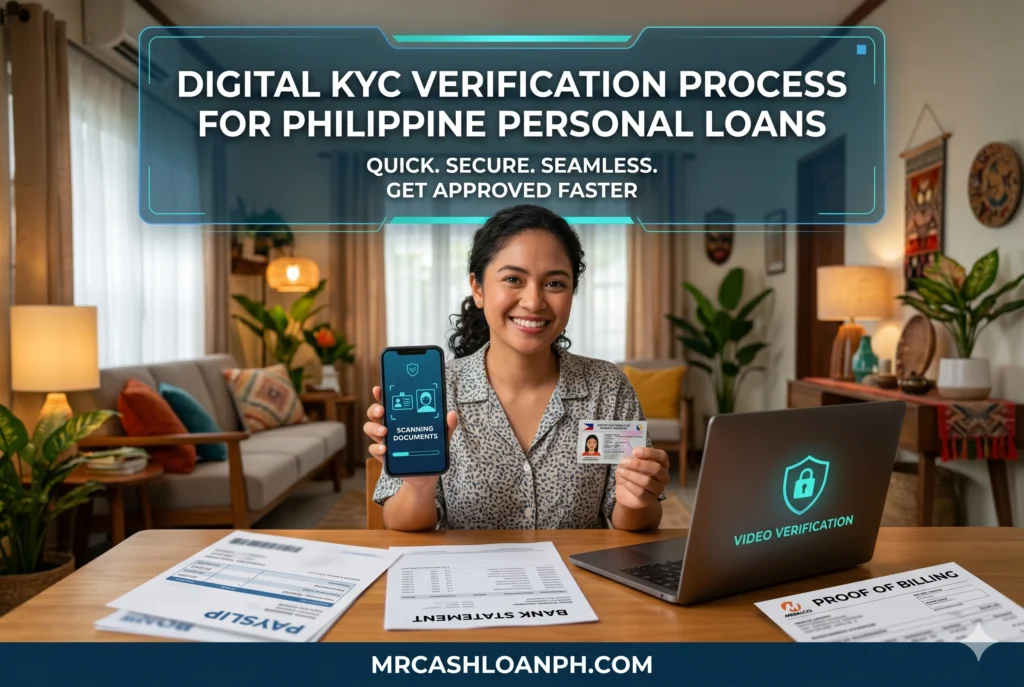
- Selfie verification
- Device fingerprinting
- Fraud detection screening
- Identity matching
Why do lenders request selfie verification?
Selfie verification helps confirm that the applicant matches the submitted ID.
Modern systems may analyze:
- Facial similarity
- Liveness detection
- Identity consistency
- Fraud indicators
This process has become increasingly common among digital lenders and mobile lending applications.
💼 Can new employees qualify for a personal loan?
Yes, but shorter employment history may result in additional verification requirements.
Many lenders prefer applicants who have completed probationary periods, although policies differ.
New employees can improve readiness by preparing:
- Updated payslips
- COE
- Payroll account records
- Additional supporting documents
A stable employment record, even if recent, generally provides stronger evidence than inconsistent employment transitions.
💻 Can freelancers and gig workers qualify without traditional payslips?
Yes. Philippine lenders increasingly recognize alternative income sources.
The growth of:
- Remote work
- Freelancing
- Content creation
- E-commerce
- Ride-hailing services
- Delivery platforms
has encouraged lenders to accept non-traditional proof of income.
Strong supporting evidence may include:
- Consistent bank deposits
- Client contracts
- Tax filings
- Platform earnings reports
- Digital payment histories
Applicants often succeed when they focus on demonstrating income consistency rather than income source type.
🚫 Why do personal loan applications fail even when income seems sufficient?
Application issues often originate from documentation or verification weaknesses rather than income alone.
Common causes include:
- Incomplete requirements
- Inconsistent personal information
- Unverifiable employment
- Poor-quality ID images
- Address discrepancies
- High existing debt obligations
- Missing income records
Many borrowers researching why applications fail focus exclusively on salary levels, yet verification quality frequently plays a larger role during initial screening.
✅ What should borrowers prepare before submitting an application?
A complete and organized document package reduces delays and improves verification efficiency.
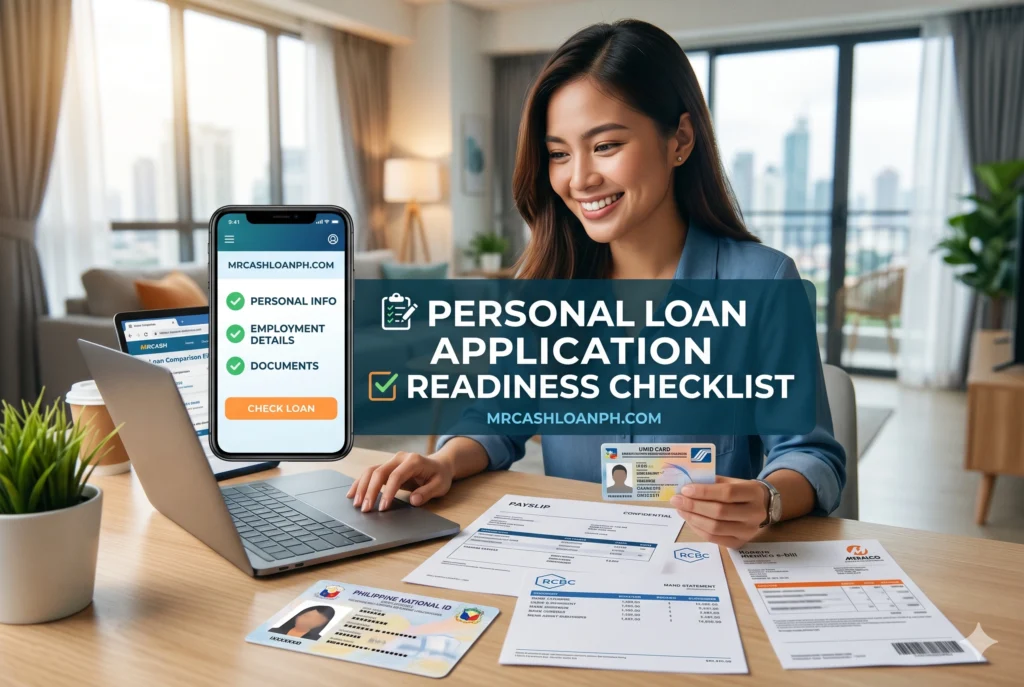
Recommended pre-application checklist
Identity Documents:
- Valid government ID
- Secondary ID if available
Income Documents:
- Payslips
- COE
- Contracts
- Tax records
- Bank statements
Contact Verification:
- Active mobile number
- Active email address
Address Verification:
- Proof of billing
- Updated residential information
Financial Readiness:
- Review existing obligations
- Check credit records
- Verify banking information
Borrowers researching a personal loan philippines application often benefit from completing this checklist before comparing lenders.
❓What documents are mandatory for most personal loan applications?
At minimum, most lenders require a valid government-issued ID and verifiable proof of income.
Additional requirements depend on lender policies, loan amount, borrower profile, and risk assessment outcomes. Some lenders may request bank statements, proof of billing, or employment documentation during verification.
❓Can I qualify if I am self-employed or running a small business?
Yes. Self-employed borrowers regularly qualify when they can document business activity and income generation.
Tax records, DTI or SEC registrations, bank statements, invoices, and business permits are commonly used to demonstrate repayment capacity.
❓Do all lenders require a Certificate of Employment (COE)?
No.
While many banks request a COE, some digital lenders rely on alternative verification methods such as payroll deposits, bank statements, income records, or digital transaction histories.
❓Can I use e-wallet transaction history as proof of income?
Sometimes.
Certain digital lenders may consider transaction records from legitimate e-wallet activity, especially when paired with bank statements and other supporting income documentation.
❓Should I check my credit report before applying?
Yes.
Reviewing your credit information beforehand can help identify errors, outdated information, or reporting issues that could affect lender evaluation. The CIC allows borrowers to access their credit information through accredited channels.
Conclusion
Preparing for a personal loan application in the Philippines is largely about verification readiness rather than simply meeting a salary threshold. Lenders want evidence that your identity is genuine, your income is stable, your information is consistent, and your repayment capacity is realistic.
Whether you are an employee, freelancer, or business owner, gathering valid IDs, income records, bank statements, and address documentation before applying can significantly improve the process. Understanding how loan verification checks work also helps borrowers avoid common mistakes that create delays or additional scrutiny.
Responsible borrowing starts long before approval—it begins with accurate documentation, transparent financial records, and realistic expectations about lender requirements.
References
- Credit Information Corporation (CIC)
Organization: Credit Information Corporation
Resource: Getting Your Credit Report with Credit Score
URL: https://www.creditinfo.gov.ph/getting-your-credit-report-credit-score - Credit Information Corporation (CIC)
Organization: Credit Information Corporation
Resource: About Your CIC Credit Report
URL: https://www.creditinfo.gov.ph/about-your-cic-credit-report - Credit Information Corporation (CIC)
Organization: Credit Information Corporation
Resource: Submission of Data to the CIC
URL: https://www.creditinfo.gov.ph/submission-data-cic - Credit Information Corporation (CIC)
Organization: Credit Information Corporation
Resource: Implementing Rules and Regulation of the Credit Information System Act (RA 9510)
URL: https://www.creditinfo.gov.ph/implementing-rules-and-regulation-credit-information-system-act-cisa-republic-act-no-9510
Community & User Experience Sources
- Reddit Community Discussion
Organization: r/phbankloan
Resource: Personal Loan Employer Verification Experiences
URL: https://www.reddit.com/r/phbankloan/ - Reddit Community Discussion
Organization: r/bankloansph
Resource: Personal Loan Requirements Shared by Borrowers
URL: https://www.reddit.com/r/bankloansph/
Last Updated on September 9, 2026 by David Vargas
