
You are staring at your phone, short on rent or facing a sudden medical bill, and your screen is flooded with ads for instant cash. You are hesitant, and frankly, you have every right to be. We have all heard the terrifying stories of digital lenders accessing personal phonebooks, blasting text messages to coworkers, and sending death threats over delayed payments.
Let us clear the air right now with a legal fact: under Article III, Section 20 of the 1987 Philippine Constitution, no person shall be imprisoned for non-payment of a civil debt. You have rights, and you do not have to endure abuse to get through a financial tight spot. As fintech analysts who spend our days tearing down and testing these platforms, we know exactly how to separate safe lenders from digital loan sharks. This page exists to walk you safely through the verified lending ecosystem.
Summary:
Finding a legitimate online loan in the Philippines requires checking two non-negotiable regulatory markers: an active Securities and Exchange Commission (SEC) Registration and a specific Certificate of Authority (CA) to operate a lending or financing company. Legitimate platforms strictly cap their nominal interest rates at 6% per month in compliance with the Bangko Sentral ng Pilipinas (BSP), conduct verified electronic Know Your Customer (eKYC) checks, and never demand access to your phone’s contact list. By cross-referencing your chosen app against the official SEC database and knowing the red flags of predatory lenders, you can secure emergency funding without compromising your privacy, safety, or mental health.
Safe Lending vs. Predatory Apps: Key Takeaways
| Feature | Verified Legitimate App | Predatory / Illegal App |
| SEC Registration | Clearly displays Corporate Name, SEC Registration No., and CA No. | Missing, faked, or uses another company’s credentials. |
| Interest Rates | Capped at 6% per month (BSP Circular 1133). | Charges 20% to 50%+ hidden deductions upfront. |
| Data Privacy | Only requests camera (for eKYC) and location. | Forces you to grant access to your Contacts and Gallery. |
| Collections | Uses official channels, offers restructuring options. | Uses profanity, death threats, and contacts your family. |
What Exactly Makes a Loan App Legal in the Philippines?
To be legally recognized in the Philippines, an online lending app must hold a valid corporate SEC Registration, possess a Certificate of Authority (CA) explicitly for lending, and adhere to BSP interest rate ceilings and National Privacy Commission (NPC) data guidelines.
When our team evaluates a new digital credit product, we do not just look at the app store reviews. App store ratings can be easily manipulated with paid bots. Real legality is grounded in strict regulatory compliance. The SEC issued a moratorium on new Online Lending Apps (OLAs) a few years back to clean up the market, meaning any legitimate app operating today has gone through heavy scrutiny. They are required to clearly display their operating credentials on their website, promotional materials, and within the app’s user interface.
How Do I Know if an App Has a Certificate of Authority (CA)?
A legitimate lender will always display their Certificate of Authority (CA) number on their homepage and inside the app; you can verify this exact number against the SEC’s official published list of authorized lending companies.
Do not be fooled by apps that only claim to be “SEC Registered.” Any group of people can register a corporation for general business purposes. To legally lend money, that corporation needs a secondary license: the Certificate of Authority. When we test an app, we look for the mandatory disclosure text, usually found at the very bottom of the launch screen or website footer. It should read exactly like this: “Corporate Name. SEC Registration No. XXXXX. Certificate of Authority No. YYYYY.” If an app hides this information or makes it difficult to find, close it immediately.
What Are the BSP Interest Rate Limits for Online Lenders?
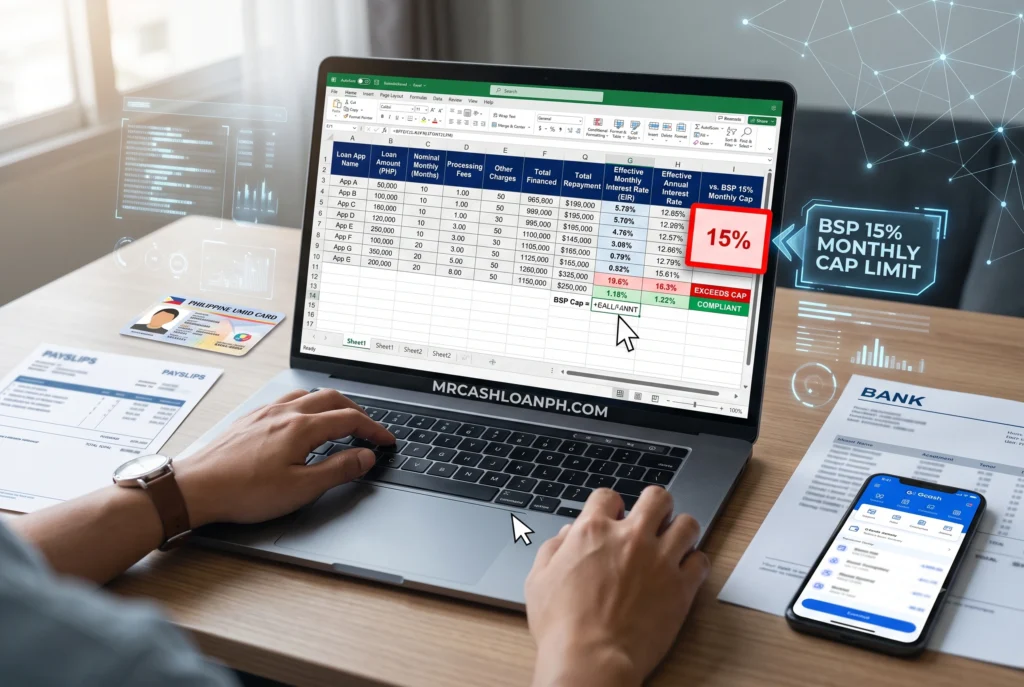
The Bangko Sentral ng Pilipinas (BSP) limits the maximum nominal interest rate for short-term online loans to 6% per month, with an effective interest rate (EIR) cap of 15% per month including all processing fees.
A major friction point for borrowers is the shock of hidden fees. Predatory apps might advertise a 0% interest rate but deduct a massive “service fee” before sending the money. For example, you borrow Php 5,000, but only receive Php 3,000. This is highly illegal. Under BSP Circular No. 1133, legitimate lenders must clearly calculate and display the total cost of the loan before you accept the terms. Late penalties are also capped at 5% per month on the outstanding balance. If an app tries to double your debt after a single week of non-payment, they are breaking the law.
Which Top Legit Loan Apps Actually Passed Our 2026 E-KYC and Disbursement Tests?
Based on our recent compliance audits, platforms like Tala, BillEase, and JuanHand consistently pass the strict eKYC data privacy tests, offer transparent loan contracts, and disburse funds reliably without asking for illegal phonebook access.
Our analysts spent the last quarter doing live walkthroughs of dozens of applications. We used fresh SIM cards and dedicated testing devices to monitor exactly what data these apps try to scrape. The verified platforms respect your privacy. They require access to your camera to scan your ID and take a selfie, and they require your location to ensure you are applying from within the Philippines. That is where the permissions stop.
Which Lenders Offer Fast Approval Cash Loans Without Unfair Hidden Fees?
Apps like Tala and Tonik provide legitimate fast approval cash loans by using automated, AI-driven credit scoring that clearly displays the exact repayment amount down to the last centavo before you sign.
During our first-hand testing, we noticed a stark difference in how legal platforms handle approvals. Instead of relying on your phone contacts to build a shadow credit profile, legitimate lenders use alternative behavioral data and proper credit bureau inquiries. BillEase, for instance, requires proof of billing and sometimes income documents, taking slightly longer but offering much larger credit limits at banking-level interest rates. Tala requires minimal documentation, making it faster, but keeps initial credit limits lower to manage risk safely.
Are There Reliable Loan Apps Using GCash for Instant Disbursements?
Yes, most SEC-licensed platforms now partner with e-wallets, making Tala, JuanHand, and Moca Moca highly reliable loan apps using GCash for real-time fund transfers within 5 to 10 minutes of approval.
When we triggered a live disbursement on Tala during a Tuesday afternoon, the funds hit our linked GCash wallet in exactly three minutes. Legitimate lenders use official API integrations with payment gateways like InstaPay and PESONet. Predatory apps, on the other hand, often disburse via sketchy personal bank transfers or require you to message a random customer service agent on WhatsApp to receive your funds. If the money comes from an individual’s personal account rather than a corporate account, you are likely dealing with an illegal operation.
What Are the Most Common UI Friction Points When Applying?
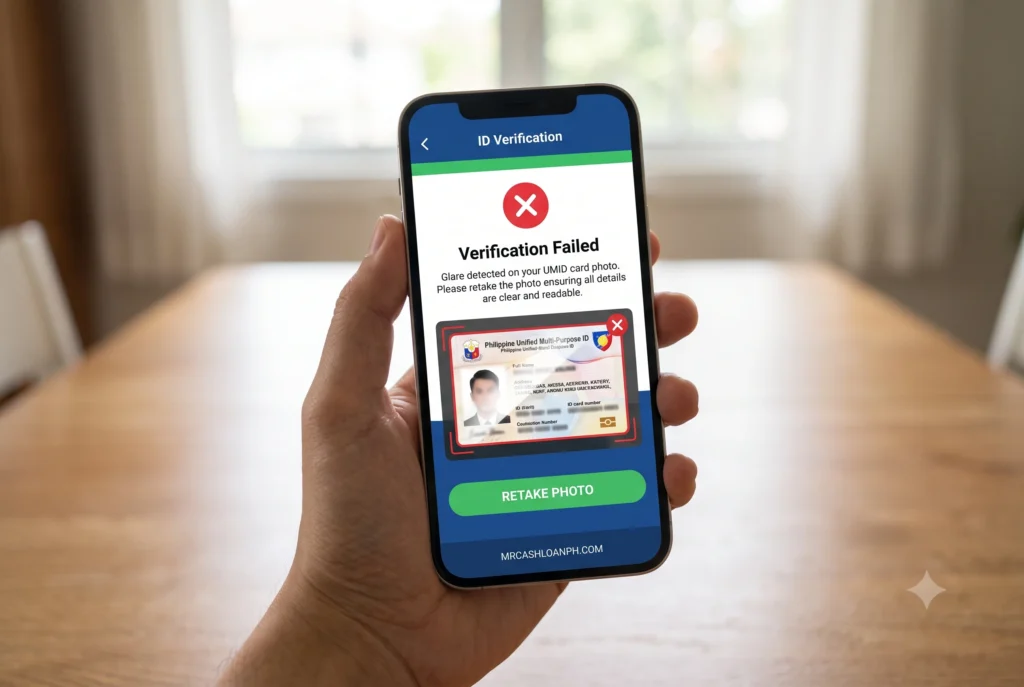
The most common hurdle during application is the automated ID verification (eKYC) failing due to blurry photos, glare, or unsupported ID types, which triggers a frustrating manual review process.
Applying for a digital loan is not always seamless, even with the best apps. Because these companies do not meet you in person, their optical character recognition (OCR) software has to do the heavy lifting. The software scans the text on your ID card and matches it against your live selfie. If your room is too dark, or if the overhead light creates a glare over your face on the card, the system will reject you.
What Happens if My Valid IDs for Online Loans Fail the Automated Check?
If your valid IDs for online loans fail the automated scan, the app will route your application to a human compliance officer, which delays approval by 24 to 48 hours and often requires submitting secondary documents.
In our experience testing the system, physical card quality matters immensely. For example, Tala’s automated eKYC might reject older UMID cards with faded borders or scratched laminates. The new PhilID (National ID) is widely accepted, but if you are using the paper-printed ePhilID, the QR code must be perfectly clear for the scanner to read it. If your primary ID fails, many platforms will ask for a secondary form of identification like a passport, driver’s license, or even a recent electric bill in your name. To avoid this friction, always wipe your camera lens, place your ID on a flat, dark surface, and rely on natural daylight rather than harsh indoor bulbs.
How Do I Protect My Data From Blacklisted Loan Apps?
You must refuse to install apps that demand permissions for your Contacts, SMS inbox, or Photo Gallery, and strictly report any threatening lenders to the National Privacy Commission (NPC).
Let us be completely clear about how the illegal apps operate. They weaponize your desperation. When you install a predatory app, a prompt will pop up asking for access to your contacts. If you click ‘Allow’, the app instantly copies every phone number you have saved. The moment you are one day late on a payment, they use automated software to text your boss, your mother, and your friends, falsely claiming that you named them as a co-maker or guarantor. The National Privacy Commission (NPC) explicitly forbids this practice under Circular No. 20-01. Legitimate companies never need your contact list to issue a loan.
Where Can I Officially Verify SEC Registration and Check Revoked Lenders?
You can directly verify SEC registration by downloading the List of Lending Companies and the List of Revoked/Suspended Apps directly from the official Securities and Exchange Commission (SEC) Philippines website.
Do not trust third-party blogs or social media comments to tell you if an app is safe. The SEC updates their database regularly. If you encounter an app with aggressive advertising, check the SEC’s specific advisory page regarding blacklisted loan apps. Companies that have been caught issuing threats, charging 50% weekly interest, or failing to set up a mandatory consumer protection desk have their CAs permanently revoked and are listed publicly by the government. Always do this five-minute background check before handing over your sensitive government IDs.
What Should I Do If I Can’t Pay My Loan on Time?
If you cannot meet your due date, you should proactively contact the lender’s official customer service channel before the deadline to request a payment extension or a debt restructuring plan.
We understand the panic that sets in when the due date arrives and your bank account is empty. The instinct is often to uninstall the app and throw away the SIM card. However, if you borrowed from a verified, legal platform, running away actually hurts you more by destroying your credit score with the Credit Information Corporation (CIC).
Instead, reach out. Legitimate lenders are required to have fair collection practices. When our team tested customer support channels for top apps, we found that sending an email requesting a restructuring plan often yields results. You can ask to break the principal amount into smaller, manageable chunks. You will still incur late fees – there is no escaping the math of borrowing – but a legal platform will work with you, whereas an illegal one will just start shouting.
Take a breath, assess your budget, and compare monthly interest rates carefully before ever taking out another loan to cover an existing one. Falling into a cycle of “tapal system” (borrowing from one app to pay another) is a dangerous trap. Borrow only what you can reasonably pay back from your next verifiable paycheck. Stick to the regulated market, protect your digital privacy, and remember that financial safety always comes before fast cash.
References
- Bangko Sentral ng PilipinasOrganization: Bangko Sentral ng Pilipinas (BSP)Resource: Circular No. 1133 – Ceilings on Interest Rates and Other Fees Charged by Lending Companies, Financing Companies, and Their Online Lending PlatformsURL: https://www.bsp.gov.ph/Regulations/Issuances/2021/c1133.pdf
- Securities and Exchange CommissionOrganization: Securities and Exchange Commission (SEC) PhilippinesResource: List of Registered Lending Companies and Revoked EntitiesURL: https://www.sec.gov.ph/lending-companies-and-financing-companies-2/list-of-lending-companies/
- National Privacy CommissionOrganization: National Privacy Commission (NPC)Resource: NPC Circular No. 20-01 – Guidelines on the Processing of Personal Data for Loan-Related TransactionsURL: https://www.privacy.gov.ph/wp-content/uploads/2020/10/NPC-CIRCULAR-NO.-20-01.pdf
Last Updated on September 9, 2026 by David Vargas
