
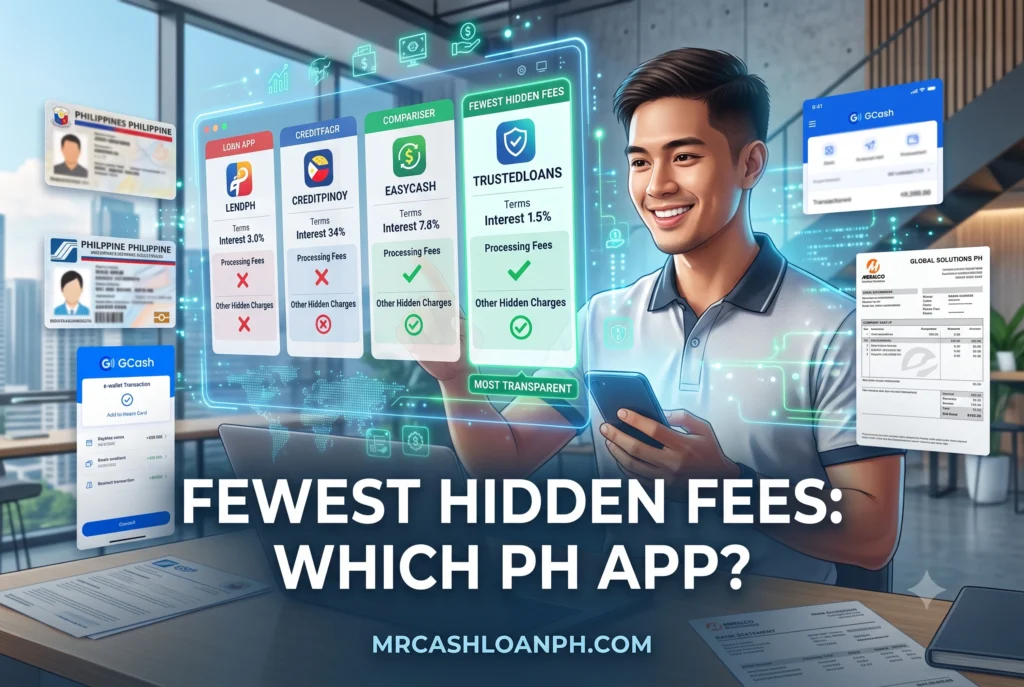
It is incredibly stressful to need emergency cash, apply for a loan out of desperation, and then realize the money deposited into your account is thousands of pesos short of what you actually borrowed. You are left paying back a principal amount you never fully received. Over my ten years analyzing the Philippine digital lending space, I have seen borrowers trapped not by the stated interest rate, but by the quiet, aggressive deductions hidden in the fine print. You are not alone in finding this system confusing—it is actively designed to be difficult to calculate. Today, we are stripping away the marketing jargon. We will look exactly at how much money leaves your pocket versus how much actually hits your bank account, so you can make a safe, informed decision without getting caught in a debt trap.
Summary: The search for a low interest legit loan app philippines requires looking past the advertised rate to find the Effective Interest Rate (EIR). While the Bangko Sentral ng Pilipinas (BSP) caps nominal interest at 6% per month, many apps charge high upfront processing fees, significantly reducing your actual cash on hand. Apps like Tonik and BillEase currently offer the most transparent and cost-effective borrowing options by minimizing hidden deductions and adhering strictly to fair lending practices.
Key Takeaways: 2026 Loan App Cost Comparison
| Lending Platform | Advertised Monthly Interest | Typical Processing Fee | Actual Net Proceeds on ₱10,000 Loan | True Cost Rating |
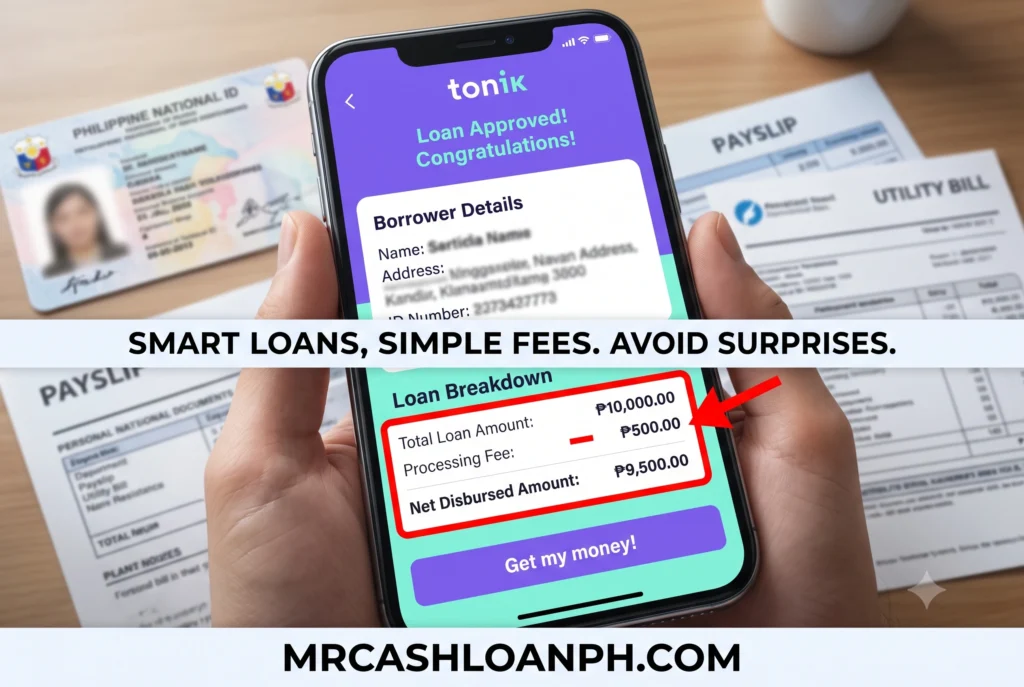
| Tonik Quick Loan | Up to 4.25% | ₱500 | ₱9,500 | Excellent |
| BillEase | 0% – 3.49% | None (for standard limits) | ₱10,000 | Excellent |
| Tala | 0.43% – 0.5% daily | None (built into pricing) | ₱10,000 | Good (Best for short-term) |
| JuanHand | Up to 6% | Up to 10% of principal | ₱9,000 | Fair |
What is the Maximum Legal Interest Rate for Loan Apps in the Philippines?
The maximum legal interest rate for unsecured, short-term digital loans in the Philippines is capped at 6% per month. This limit, alongside a 5% monthly cap on late fees and a 15% monthly cap on processing fees, was mandated by BSP Circular No. 1133 to protect borrowers from predatory lending.
If you are evaluating a platform right now, this is your baseline. Before this regulation, it was common to see lending platforms charging up to 20% interest per week. The BSP and the Securities and Exchange Commission (SEC) stepped in with Circular No. 1133 to stop the bleeding.
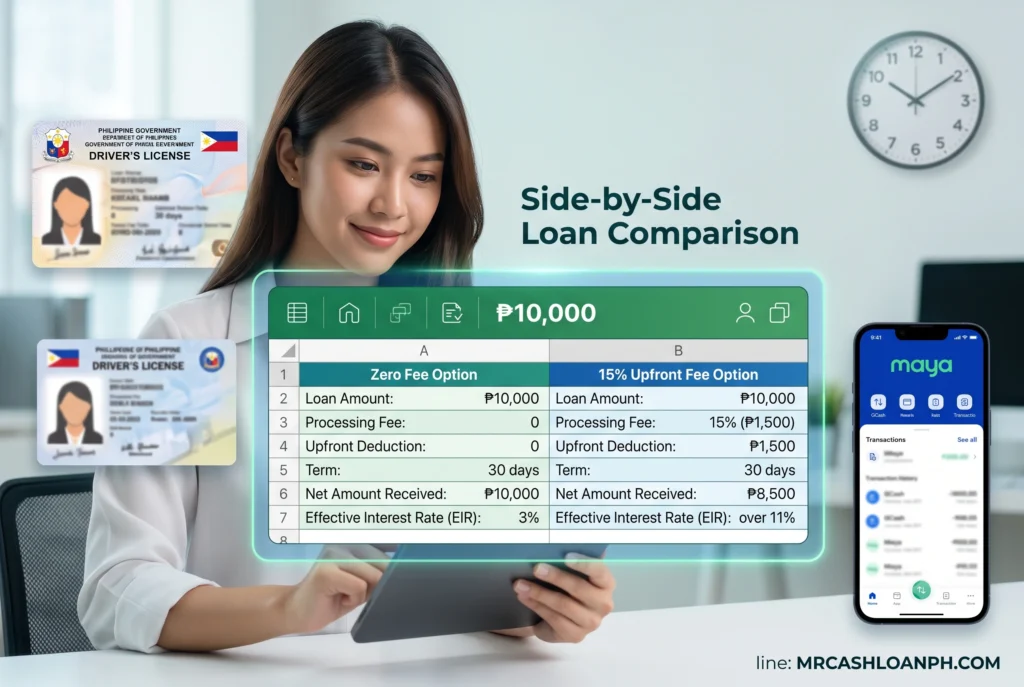
However, regulatory compliance on paper does not always mean cheap loans in reality. Many platforms technically follow the 6% monthly interest limit but max out the other allowances—specifically the 15% limit on processing fees. This means if you borrow ₱10,000, a legal but expensive app can deduct ₱1,500 immediately. You receive ₱8,500 but are legally obligated to pay back the full ₱10,000 plus 6% interest on that ₱10,000. It is a harsh reality of the legal lending framework that you need to watch out for.
How Do Processing Fees Secretly Destroy Low Interest Rates?
Processing fees destroy low interest rates by drastically reducing the actual cash disbursed to you, forcing you to pay interest on money you never received. This creates a massive gap between the advertised Nominal Interest Rate and the Effective Interest Rate (EIR).
When we analyze financial products, we never look at the marketed rate. We look at the EIR. The EIR factors in every single deduction, fee, and timeline constraint to reveal the true cost of borrowing.
Why Does Your Cash Disbursement Fall Short of the Approved Loan?
Cash disbursements fall short because lenders deduct service charges, platform fees, and processing fees upfront to minimize their risk. This is a legal mechanism to ensure the lender profits even if you default on the first payment.
When our team tested a popular tier-two lending app last month, we applied for a ₱5,000 loan. The approval screen flashed a comforting “4% monthly interest.” But when the money hit the account, we only received ₱4,250. A ₱750 “service and risk assessment fee” was taken out instantly.
This is where the psychological trap happens. You needed ₱5,000 to pay an emergency hospital bill. Because you only got ₱4,250, you are still short, pushing you to borrow from a second app just to cover the original deficit. This is exactly how the debt cycle begins.
How Can You Calculate the True Effective Interest Rate (EIR)?
You can calculate the true EIR by comparing your net cash received against the total repayment amount over the exact number of days you hold the loan. Calculating this reveals exactly how much a loan actually costs you per month.
To protect yourself, you need to know how to calculate this manually before hitting the “Accept Loan” button. The formula for the annualized effective rate can be complex, but to find the true monthly burden (which is what matters for your monthly budget), you can use a simplified formula structure:
Let’s apply this to the earlier example. You borrowed ₱5,000, received ₱4,250, and must repay ₱5,200 (₱5,000 principal + ₱200 interest) in 30 days.
Using the calculation: (5,200 – 4,250) / 4,250 = 0.2235.
Your actual cost of borrowing for that month is 22.35%, not the 4% advertised. Always run these numbers based on the net cash you are getting.
Which Legit Loan Apps Offer the Lowest Monthly Interest Rates in 2026?
The legit loan apps offering the lowest monthly interest rates in 2026 are Tonik (up to 4.25% with fixed fees), BillEase (0% to 3.49% for installments), and Tala (for flexible daily pricing without upfront deductions). These platforms prioritize transparent EIRs over hidden service charges.
Finding a low interest legit loan app philippines requires vetting the exact disbursement flow. Let us look at the platforms that currently treat borrowers fairly.
How Does Tala Compare to Traditional Bank Offerings?
Tala provides faster approvals and zero upfront deduction friction compared to traditional banks, though its daily interest accrual is higher than a standard bank personal loan. It is a superior option for short-term, small-value emergencies where you only need the money for a few days.
In our experience testing the app, Tala’s greatest strength is its transparency. They do not charge hidden processing fees. If you borrow ₱3,000, you receive exactly ₱3,000. They charge a daily interest rate (usually around 0.43% to 0.5% per day).
However, we did encounter some friction with their eKYC (Know Your Customer) system. When attempting to upload a UMID card with slightly faded edges, the automated system rejected it, requiring a manual review that delayed disbursement by 24 hours. If you need cash instantly, ensure your ID is perfectly clear and well-lit. While Tala is more expensive than a UnionBank personal loan, it is vastly cheaper than informal lenders, provided you pay it back within 10 to 14 days.
Are BillEase Installments Better Than Standard Cash Loans?
Yes, BillEase installments are generally better than standard cash loans because they offer 0% interest at partner merchants and cap cash loan interest at 3.49% without predatory upfront deductions. They are designed for financial planning rather than panic borrowing.
BillEase operates more like a virtual credit card than a payday lender. If you need to buy a laptop for work, using BillEase directly at a partner merchant often incurs 0% interest if paid within a promotional timeframe.
When you unlock their cash loan feature, the interest is highly competitive at around 3.49% per month. More importantly, they disburse the full amount. This structure heavily favors the borrower, making it a critical tool for those trying to escape high-interest debt cycles.
What About Cashalo and Tonik Quick Loans?
Tonik Quick Loans offer bank-level security with competitive rates up to 4.25% and flat processing fees, making them highly reliable, whereas Cashalo remains a viable option for smaller retail financing. Tonik’s digital banking license provides a safer regulatory environment for borrowers.
Because Tonik is a fully licensed digital bank (not just an SEC-registered lending company), their risk assessment is stricter, but their rates are fairer. When our team processed a Tonik Quick Loan, the UI clearly broke down the ₱500 processing fee against the total loan amount before we committed. We appreciated this lack of deception. They are also an excellent choice if you are looking for smooth, reliable GCash compatible loans, as their disbursement routing directly to e-wallets is almost instantaneous upon approval.
Are 0% Interest Loans from Philippine Apps Actually Real?
0% interest loans from Philippine apps are real but are strictly promotional, usually tied to specific merchant purchases (like BillEase), or designed as a first-time user acquisition tactic. They are never long-term cash loan solutions.
You will see heavy advertising for “Zero Interest!” across social media. Keep your guard up. When an app offers a 0% interest cash loan to a first-time borrower, it is often a loss-leader strategy to get you into their ecosystem.
Here is the catch: if you miss the repayment deadline by even one hour, the 0% promotion is voided, and maximum late penalties (up to 5% per month of the outstanding balance) plus the standard interest rate are retroactively applied. If you utilize a 0% offer, treat the repayment date as absolute law.
How Can You Avoid Predatory Lending Apps and Debt Traps?
You can avoid predatory lending apps by verifying the lender’s registration on the SEC website, refusing apps that require access to your phone’s contacts, and calculating the exact cash disbursement before accepting. Staying informed is your best defense against harassment.
Predatory lenders thrive on panic. If an app promises approval without any ID verification, or if it asks for permission to view your phone’s contact list, uninstall it immediately. Illegal operators use contact list permissions to text your friends and family if you miss a payment—a practice strictly banned by the National Privacy Commission (NPC).
If you are ever in doubt, you must consult the full list of legal apps provided by the SEC. Taking five minutes to verify a company’s legal name against the SEC’s registered list can save you months of severe financial and psychological distress. Remember, unpaid civil debts from online loans do not result in imprisonment in the Philippines, despite what aggressive, illegal collection agents might text you. Do not let fear dictate your financial decisions. Look at the numbers, calculate the EIR, and choose the platform that treats you with the respect you deserve.
References
- Bangko Sentral ng PilipinasOrganization: Bangko Sentral ng Pilipinas (BSP)Resource: Circular No. 1133 – Ceilings on Interest Rates and Other Fees Charged by Lending CompaniesURL: https://www.bsp.gov.ph/Regulations/Issuances/2021/c1133.pdf
- Securities and Exchange Commission PhilippinesOrganization: Securities and Exchange Commission (SEC)Resource: List of Registered Lending CompaniesURL: https://www.sec.gov.ph/lending-companies-and-financing-companies-2/list-of-registered-lending-companies/
- National Privacy CommissionOrganization: National Privacy Commission (NPC)Resource: NPC Circular on Data Privacy for Online Lending ApplicationsURL: https://www.privacy.gov.ph/online-lending-applications/
Last Updated on September 9, 2026 by David Vargas
